The Art That Belongs to Miami: Faena's Three Art Week Commissions Are the Most Important Public Art of the Season
A monumental disco ball echoing Coltrane, a luminous Baroque crown open to everyone, and a photographic archive of the city's own soul — Faena Miami Beach makes the case that the best Art Basel art is the art that belongs to Miami, not the art that's visiting.
Part of our ongoing curation of what it means to live, love, and play in the Magic City.
Miami Art Week 2026 · December 1–6 · Faena Miami Beach
There is a version of Art Basel week that happens inside the Miami Beach Convention Center — the booths, the blue-chip galleries, the collectors moving through aisles with the quiet confidence of people who already know what they're going to buy. And then there is the version that happens outside, on the beach, in the streets, in the hotels that have decided to treat the week as a curatorial opportunity rather than a revenue event.
Faena Miami Beach has always belonged to the second category. Since Alan Faena and Len Blavatnik opened the property in 2015, the stretch of Mid-Beach it anchors has operated on its own frequency — more theatrical, more committed to spectacle as a form of meaning, less interested in the art world's internal hierarchies. This December, for Miami Art Week 2026, Faena presents three site-specific commissions that are among the most conceptually ambitious public art offerings of the season. All three are free. All three are about Miami. And all three are worth your time.
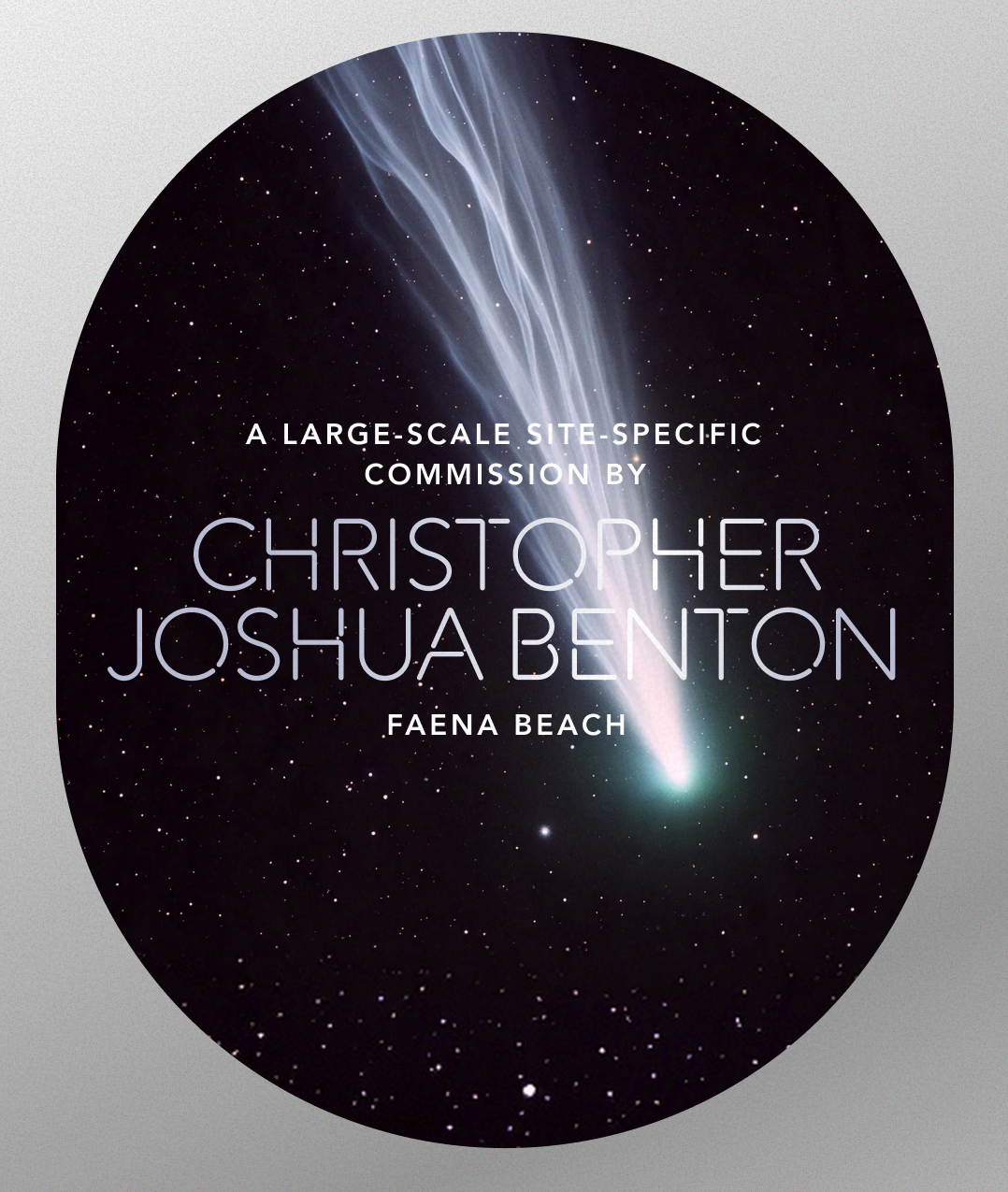
A Lore Supreme — Christopher Joshua Benton
The anchor commission of the season is A Lore Supreme by Christopher Joshua Benton — a monumental disco ball installation that stretches across Faena Beach, transforming the sand into an open-air dance floor for the duration of Art Week.
The title is doing serious work. It is a deliberate echo of John Coltrane's 1964 masterpiece A Love Supreme — one of the most spiritually charged recordings in the American canon — but Benton swaps love for lore. The move is precise: lore is inherited knowledge, the stories a community carries in its body, the cultural memory that gets transmitted not through institutions but through music, through movement, through the way people dance at a party on a Tuesday night in Little Haiti or Liberty City. A Lore Supreme maps that inheritance. It asks what it means to carry the cultural exchange of Miami's communities in your body, and it answers the question by making you move.
The disco ball — that most democratic of art objects, the one that has presided over every kind of gathering from Studio 54 to a quinceañera in Hialeah — becomes here a monument to Miami's rhythms. The piece is not passive. It is designed to activate the beach as a social space, to make the Art Week crowd — which can sometimes feel like it is performing the act of looking at art rather than actually experiencing it — stop performing and start dancing.
"The best Art Basel art is the art that belongs to Miami, not the art that's visiting."
An Expanded Baroque Crown — Marinella Senatore
Italian artist Marinella Senatore has spent her career making work that refuses to be looked at from a distance. Her practice is built on collective participation — on the idea that art is most alive when it belongs to the people who encounter it, not the people who commissioned it. An Expanded Baroque Crown continues that project in a new register.
The work is a luminous sculptural architecture — a crown, expanded to architectural scale, made radiant. In the context of Miami Art Week, when the city's public spaces are routinely cordoned off for VIP previews and private events, when the beach itself can feel like it has been temporarily annexed by the art market, Senatore's commission is a deliberate counter-gesture. The crown is not a symbol of exclusion. It is a shelter. A place to gather, to be seen, to see others. An open invitation issued in light.
The Baroque reference is not decorative. Baroque art was always about excess in the service of emotion — about overwhelming the senses to produce a feeling that could not be achieved through restraint. Senatore takes that logic and turns it outward, toward the public, toward the street.
The Magic Is You — Kevin Arrow
Kevin Arrow's The Magic Is You is the most intimate of the three commissions, and in some ways the most ambitious. A site-specific installation at Casa Faena — the residential wing of the Faena complex, a building that has always felt slightly apart from the hotel's main spectacle — it draws on photographic archives of Miami and its visual culture.
The city as it has been seen. Documented. Remembered by the people who lived it — not the people who visited it, not the collectors who come every December, but the people who were here before Art Basel arrived and will be here after it leaves. Arrow's work asks visitors to see themselves in that archive. To recognize that the magic of Miami was never in the art fair, never in the hotel lobby, never in the VIP preview. It was always in the city. It was always in the people.
The installation is presented in partnership with No Vacancy, a public art program commissioned by the City of Miami Beach in collaboration with the Miami Beach Convention and Visitors Authority — a partnership that gives the work an institutional grounding while keeping its emotional core intact. The title is a statement of faith: the magic is you.
The Position
Taken together, the three commissions form a coherent argument. Benton's work is about music and movement and the cultural inheritance of Miami's communities. Senatore's is about collective space and the refusal of exclusion. Arrow's is about memory and the city's own image of itself. All three are site-specific. All three are free. All three are, in the most literal sense, for Miami.
That is not a coincidence. It is a position. Faena has been one of the most consistent presenters of serious public art during Miami Art Week — not as a backdrop for parties, not as a marketing exercise, but as a genuine curatorial program with a point of view. The 2026 lineup is the clearest expression yet of what that point of view is: that the most important art happening during Art Basel week is the art that belongs to the city, not the art that is temporarily visiting it.
All three installations are on view December 1–6 at Faena Miami Beach, 3201 Collins Ave., Miami Beach. Free and open to the public.
The PGM Edit
A monumental disco ball echoing Coltrane, a luminous Baroque crown open to everyone, and a photographic archive of the city's own soul — Faena Miami Beach makes the case that the best Art Basel art is the art that belongs to Miami, not the art that's visiting.
Premier Guide Miami
The Live · Love · Play Dial
Major Lazer Is Headlining Faena's Art Basel Music Series — and Chase Sapphire Reserve Cardholders Get a Private Dinner
The Faena Art Music Series returns December 2 with Major Lazer headlining and Richie Hell opening. Chase Sapphire Reserve cardholders get access to a private sunset cocktail hour, an exclusive dinner called 'Transatlantic Express: A Shared Table,' and a VIP area. Tickets go on sale October 27.
Every Major Miami Institution Is Leaning In to Art Week. Here Is What That Looks Like.
From the Bass to Bakehouse, PAMM to the Wolfsonian, Vizcaya to Locust Projects — Miami's full institutional landscape is making its strongest case this December. The programming is not incidental. It is strategic.
Art Basel Miami Beach 2026: The Complete Guide to Family Programs and Free Events
Art Kids, free museum access, complimentary institution visits, and everything families need to know about navigating Art Week with children.
Where to Eat During Art Basel Miami Beach 2026: The Complete Dining Guide
From Michelin-starred omakase in Little River to Roman pasta in the Design District, the table is as curated as the show floor this December.
Independent.
·Unsponsored.
·Always Free.
Premier Guide Miami has never accepted payment for editorial coverage. Our story →